 |
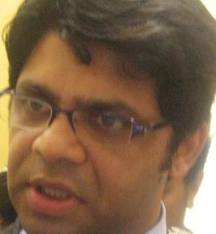
| BIBLE BASHER: Gates taking oath. |
The might of the Bible and the weight of Fiji law as it is today wasn't enough to get the country's illegal chief justice into the United States to attend a United Nations meeting.
Gates, to the outrage of the illegal government, has been denied a visa by US authorities.
He had hightailed it to New York to participate in the four-day 9th Session of the Assembly of States Parties to the Rome Statute of the
International Criminal Court, being held at the UN headquarters.
But his questionable past seems to have been a non-negotiable issue for US authorities. Gates has dual British and Australian citizenship but was one of the first on board after Bainimarama and Josefa Iloilo illegally abrogated the Constitution last year.
A furious Khaiyum took the US authorities decision hard. In a statement this afternoon, he said: "Clearly, the failure of the US embassy is specious and demeaning. In diplomatic language, the non-issuance of visa on time effectively tantamounts to a rejection.
"One wonders whether the same discourteous treatment would have been meted out to a Chief Justice of a more significant State than the small Pacific island country of Fiji.
"This behaviour was arbitrary and arrogant and inconsistent with the spirit behind the purpose of this meeting of State parties. It is much to be
deprecated. No courts treat their litigants or stakeholders in such a way."
The realities of being part of a dictatorship regime is obviously hitting home.
For the full impact, we print here Khaiyum's statement:
1. The Government of the Republic of Fiji strongly denounces the failure by the embassy of the United States of America to provide the Chief Justice of Fiji, Mr. Justice Anthony Gates, with a visa to represent Fiji at the 9th Session of the Assembly of States Parties to the Rome Statute of the International Criminal Court ("Rome Statute"), which is being held at the headquarters of the United Nations in New York from 6 to 10 December 2010.
The invitation to this meeting was extended to Fiji by the International Criminal Court ("ICC").
2. Earlier this May, the Attorney-General with Mr. Luke Daunivalu, Fijis' Deputy Representative to the United Nations, had represented Fiji at the meeting for the review of the Rome Statute, which was held in Uganda and was attended by all the States parties to the Rome Statute, as well as a large array of international judges, jurists and international and criminal law experts.
3. In the last year, Fiji has made substantial progress to ensure full compliance with the Rome Statute, with the implementation of the Crimes Decree ("the Decree"). The Decree contains modernised and internationally accepted provisions on various offences against the international order, including the offence of genocide, crimes against humanity, trafficking in persons and children, people smuggling, piracy, slavery and sexual servitude.
4. Given such an advanced accomplishment with respect to its laws, which numerous other countries are yet to achieve, it was imperative that Fiji was suitably represented by our senior-most judicial officer. As such, the Fijian Government, at the invitation of the ICC, had nominated the Chief Justice to represent Fiji at this important meeting. The ICC secretariat, in consultation with Fiji's representative to the UN, had already confirmed an allocated time for Justice Gates to make a presentation on behalf of Fiji, on Tuesday morning (7 December 2010).
5. It is most unfortunate and gravely disappointing that Fiji was, yet again, frustrated in its attempts to adequately make representations to this meeting of the ICC, including meetings of other international organisations in which Fiji is active participant, as a result of this contemptible conduct on the part of the US embassy.
6. Fiji, as a responsible sovereign State, and the Fijian Government take international responsibilities and obligations with utmost sincerity. In relation to the Rome Statute, Fiji is entitled to inform and update this meeting of eminent jurists and international law experts about the developments and progress made by Fiji in relation to the implementation of the Rome Statute
7. The Chief Justice was unable to attend this meeting because the American authorities failed to issue him with an entry visa. His application was initiated and lodged with the US embassy within sufficient time.
8. Whilst no formal message declining the visa has been issued, as sual it will be said there was insufficient time to process the application, or that the visa would have been issued eventually.
9. It is noted that this deplorable and undignified stand has recently been taken by the US embassy in relation to applications for visa by the Attorney-General, who had in October been scheduled to attend the UN General Assembly with the Prime Minister. Similarly, the Permanent Secretary for Fisheries & Forests has also not been given a visa to represent Fiji at the annual session of the Western and Central Pacific Fisheries Commission, scheduled in Hawaii from 5 to 10 December 2010.
10. Clearly, the failure of the US embassy is specious and demeaning. In diplomatic language, the non-issuance of visa on time effectively tantamounts to a rejection. One wonders whether the same discourteous treatment would have been meted out to a Chief Justice of a more significant State than the small Pacific island country of Fiji.
11. This behaviour was arbitrary and arrogant and inconsistent with the spirit behind the purpose of this meeting of State parties. It is much to be deprecated. No courts treat their litigants or stakeholders in such a way.
12. Fiji will now be represented at this meeting by its Permanent Representative to the United Nations, Mr. Peter Thomson and his deputy, Mr. Luke Daunivalu.
Aiyaz Sayed Khaiyum
(Illegal) Attorney General
 + Enlarge this image


