Sunday, January 23, 2011

Fiji faces ejection from Rugby World Cup


The International Rugby Board (IRB) has taken the drastic action of warning Fiji that it could be kicked out of rugby ahead of World Cup over a power tussle in the island nation where the military regime has demanded its board quit.
The IRB’s top officials say they will travel to Fiji next month to investigate the deepening crisis.
Earlier this month Commodore Voreqe Bainimarama’s regime said that the Fiji Rugby Union (FRU) board and executive would have to quit before they received F$3 million (NZ$2 million) to play in New Zealand.
The board quit and last week the CEO Keni Dakuidreketi – a long a target of Bainimarama attacks – also quit.
A special board meeting was to be held next week to appoint a board that would meet the approval of the military.
However on Friday the IRB wrote to the FRU and warned them not to hold a special meeting and to reject Dakuidreketi’s resignation so that he remained as CEO.
"In light of the prevailing circumstances, there should be no changes within the senior management structures of FRU," the IRB letter said.
They warned it was not prudent to hold the special meeting and said "that any action in contravention of the Constitution of the FRU will result in the Union potentially not remaining in good standing as a member of the Union of the IRB which may result in the IRB having to take a determination on the continued membership of the IRB of the FRU".
Interim FRU chairman Rafaele Kasibulu says the letter also advised that IRB chairman Bernand Lapisset and the CEO of the IRB Mike Miller will meet the existing board next month.
"The IRB has indicated that FRU continues to meet all the requirements of governance and has developed rugby in a manner consistent with the expectations of IRB. The Government of Fiji has been made aware of these views by IRB in writing."
Council spokesperson and legal adviser Carl Ngamoki-Cameron told the Fiji Sun the majority of the council had lost trust and confidence in the ability of the current directors to meet the expectations of all member unions and the public in promoting first and foremost the interests of rugby.
He said the Board is answerable to the FRU Council, not the IRB.
"These internal democratic mechanisms within the FRU are completely independent of the Fiji Government and whether or not it decides to financially assist the Board of the FRU that has failed to procure adequate funding for the 2011 Rugby World Cup, despite its best efforts.


"It is unfortunate that the Board has attempted to use the media to resolve internal issues at Rugby House, further eroding the reputation and credibility of Fiji Rugby locally and abroad."
The crisis began with a fundraising lottery to fund Fiji’s RWC bid. But the after police and competition authorities raided Rugby House in Suva, it was found that the lottery was to have raised over $350,000 but that $155,743 is unaccounted for.
- Stuff

Thursday, January 20, 2011

Military Regime eyes Cakaudrove


Posted on Intelligentsiya - 20 January 2011

The military regime is now "full-throttle" with their hearts and minds campaign to our rural populace.

And Cakaudrove appears to hold particular appeal.

The illegal and treasonous military regime uses one link from their pool of traditional allies to try and get Cakaudrove on board with their programme.

The much talked-up meeting between the illegal and treasonous Bainimarama and the Gone Turaga na Tui Cakau, Ratu Naiqama Lalabalavu was also hyped up and then roundly clarified.

Bainimarama realizes that bulldozing Ratu Naiqama into submission won't work, so in line with their "individualism and fragmentation" strategy, they line up the lewenivanua by dangling carrots, and getting round traditional road-blocks by attempting to make all land benefits equal and point-scoring with the young un's.

Why Cakaudrove in particular matters so much to Bainimarama and his cronies will undoubtedly see the light of day soo,n but if their publicly funded propaganda publication is anything to go by:
Vanua Levu could be turning into Fiji’s main economic base because of its rich
natural resource.
And people in the provinces of Cakaudrove, Bua and Macuata must fully utilise their land to ensure maximum returns for the economy .
 Also evident is the regime's own readiness in preparation for the economic explosion: 
With increasing potential economic activities expected from Vanua Levu’s rich
natural resources, the island lags in infrastructural development.

“Pine trees have matured and it is a good sign for economic prospects for Vanua
Levu and Fiji as a whole,” said PM, adding that the first shipment of pine chips will leave our shores from Wairikiat the end of the year.

PM has also endorsed the establishment of a new Government station in Kubulau, Bua.

The new station would be commissioned to a full District Office operation to
assist development within the district.

Government has given its full support on the operation at Wairiki port.

This development will also ensure the supply of 1.5mega watts of electricity
to Savusavu, to be sourced from the Wairiki Pine chips operation.

Villages and settlements along the Nabouwalu area to Wainunu and Kubulau
will benefit through this development.

Minerals exploration in Nawailevu, Bua is taking off at a good pace creating a positive impact on the local economy with employment etc and given that this is known to be one of the promising fields of rocks containing aluminium hydroxides, which is the principal ore of aluminium.

There is also bauxite mining planned for the Nabouwalu region, with landowners now seeking PM’s assistance to transfer their land to the Land
Bank following talks with landowners.

PM Bainimarama said the road upgrades planned for Nabouwalu to Dreketi next year is geared to generate more economic activities for the Bua and Macuata provinces.

“Government has spent $.7million on road upgrade works from Vusasivo, Wailevu, Natewa and Tunuloa and $275,000 from Lavena to Naselesele, which
is now complete.

“Governments has also spent $.6million on rural electrification solar programme in villages around Cakaudrove province which has also completed.

“ G o v e r n m e n t ’ s upgrading works and more developments are for the betterment for everyone in Vanua Levu and better accessibility to services
provided by Government,” Bainimarama added.

He then said more upgrading of roads is expected to commence in 2011, which will see Northerners have access to good roads while utilising their resources and contributing to the economy.

Tuesday, January 18, 2011

New appointments: daddy's little girl and dodgy highflyers

SAI'S COMMENTS:

  • As 2011 begins, the illegal regime's approach to national affairs remain the same as evidenced by the story in this piece.

  • Nepotism and the rewarding of regime supporters and fellow travellers remain a hallmark of the way the regime recruits people. Let alone the lack of transparency over the appointment process as it railroads its preferred candidates to posts in government. 

  • The appointment of the Dictator's daughter is a case in point. Be good to learn of her credentials and capabilities, other than being the daughter of Fiji's illegal PM and Dictator.

  • As Fiji welcomes reluctantly another year under a military dictatorship, one thing is certain - Fiji and its people are destined for another rough year under an illegal regime.

  • The only hope for salvation is for a TUNIISIA for Fiji - where a dictator gets kicked out by the people fed up with the NEPOTISM and dictatorial rule of a Despot. 

  • For Fiji's sake I pray it happens much much sooner than later.

posted on coup four point five - WEDNESDAY, JANUARY 19, 2011

More behind the scene movements today the people of Fiji are unlikely to be told about officially.

Top of the list is news the daughter of the self-appointed leader, Voreqe Bainimarama, Litiana, has been made CEO of the Fiji Sports Council.

Litiana was deported from New Zealand following the 2006 coup because of her connections (she was apparently given the flick by her then husband for the same reason) and used to work for Transtel, the Telecom Fiji subsidiary. 
More openly, the illegal attorney-General and Minister for Public Enterprises, Aiyaz Sayed-Khaiyum, has named two new appointments to the board of directors for Airports Fiji Limited (AFL).

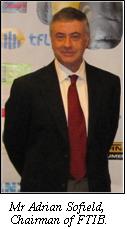
They are Adrian Sofield, the chair of the Fiji Islands Trade and Investment Bureau (FTIB) and Faiz Khan, a lawyer. Sofield (pictured) has been appointed chair of AFL and Khan director and both have been signed up for three years. 

But not stated by the Khaiyum presser today is Sofield's earlier business activities. In the nineties, he is reported to have admitted to bribing the Mayor of Suva to speed up consent for the approval of a condominium site he was in charge of at Queen Elizabeth Drive.

Sofield was struck of by the Fiji Institute of Architects and the site today belongs to the Chinese Embassy.

Worth noting, also, is the pending departure of the publisher of the Fiji Times, Dallas Swinstead, after just five months. He was brought in by owner Mac Patel to help the paper 'cross over' after the forced News Ltd sale. 


Owner and publisher have both frothed about the Australian's contribution in re-inforcing the Fiji Times as the country's "most important paper" but many would agree that's an exxageration.

Less enthusiastic to discuss his future is Brigadier Colonel Mohammed Aziz, who is now rumoured to be of all boards and languishing at home after losing favour with fellow conspirators.

Wadan Narsey: Helping FNPF despite media censorship


Sai's Comments:
  • This is another great piece by Wadan Narsey on the plight of the FNPF as the illegal regime continues to plunder the national savings of Fiji citizens.
  • Whatever efforts are available to help prop up FNPF, it must be explored and Wadan identifies a number of ways in this piece. Chief among these is to try to invest in FNPF ventures that yield return for locals and not foreign ones.
  • While these may seem to limit consumer choices, it would certainly go some way to help salvage FNPF ventures thereby keep funds in Fiji.

POSTED ON COUP FOUR POINT FIVETUESDAY, JANUARY 18, 2011

FNPF WEBSITE PIC: A charade. Below: Natadola and Narsey.

By Professor Wadan Narsey 

Can FNPF contributors and pensioners assist FNPF to become more viable?
With a stagnating economy FNPF revenues have been severely constrained. Few new jobs have been created and existing incomes have not grown; many loans are non-performing; returns on FNPF investments have been declining;  and large amounts of capital values have been written off because of mismanagement.

But collectively, FNPF contributors and pensioners remain the largest group of spenders in the Fiji economy.

Here is the challenge: can FNPF contributors and pensioners direct their consumption expenditure towards FNPF investments, and change FNPF policies for the better?

Can FNPF management encourage this by providing financial incentives and changing their management structure?

Can all FNPF stakeholders (FNPF itself, unions, pensioners, civil servants etc) conduct marketing campaigns in the aid of FNPF assets and loans?

If such campaigns work, others may lose: but given the current pressures on FNPF,  FNPF contributors and pensioners must look after our own life savings first.

FNPF investments and loans
What are the FNPF investments and loans?  By far the largest disposition of FNPF funds is in the form of loans to the Fiji Government.

Then there are other investments and large loans: the giant ATH, the Intercontinental Hotel and Golf Course at Natadola, Fiji Sugar Corporation,  Home Finance,  Holiday Inn, the Grand Pacific Hotel (currently used by backpacking soldiers), Penina Ltd (Tappoos City), and numerous others on which there is little information in FNPF’s 2010 Annual Report.

How can FNPF contributors  and pensioners encourage these loans and investments “come good” for FNPF?

The easy nuts to crack
To which FNPF investments and loans can FNPF contributors and pensioners direct their spending, so as to improve returns to FNPF?  Some are quite easy to see.

Home loans may be taken from Home Finance Corporation (HFC), rather than giving the business to other financial institutions, many of which are foreign owned enterprises which export their profits.

Holiday Inn facilities could be used wherever possible, for conferences, food, and leisure activities.

The accommodation, conference, golfing facilities at the Intercontinental (Natadola) could be used wherever possible rather than the alternatives which are often used. (Can we renegotiate a restoration of Vijay Singh’s endorsement of the Golf Course?)

FNPF consumers could, wherever possible, use the Tappoo City retail outlets to which more than $40 million of FNPF funds have been lent.

Workers at FSC (lent more than $50 million of FNPF funds) must do all they can to ensure that the mills work efficiently, producing maximum sugar output, with minimum break-downs.

Those large unions with entrepreneurial abilities (FTUC, FPSA, FTU, FTA) can assist FNPF investments in GPH and Momi “come good” instead of the disasters they seem destined to be under this military Government.

What can FNPF management do?
If FNPF gets around to issuing ID cards to FNPF contributors and pensioners, then FNPF investments or receivers of FNPF loans could be encouraged to give discounts to FNPF card-holders.

There could be special discounts on interest rates for Home Finance loans.

There could be discounts on bills at Holiday Inn.  [FNPF management could get some commercial advice on how to make Holiday Inn become the gold mine that it should be, taking advantage of the glorious location, overlooking the harbor and the mountains, with more attractive prices for drinks and food].

There could be serious discounts on accommodation, food, and golf fees at the Intercontinental Natadola to ensure that it operates close to 100% capacity, by attracting more business from Suva and other population centres.

Tappoo City outlets could offer discounts on all FNPF card holders but the City Council can also help.  Look out the top floor windows of the Tappoo City building, and admire the mountains, the beautiful bay, and then right below your eyes, is the garbage on the roof of the Nabukulou Fish market, and the Garrick Hotel roof, reducing the value of FNPF’s multi-million dollar investment in Tappoo City.

What are all the other Fiji investments where FNPF revenues may be directly or indirectly encouraged?

The tough nuts to crack
Loans to Government will be repaid to FNPF more easily if there is healthy economic growth, allowing Government tax revenues to grow healthily.

For this to happen, each and every FNPF contributors and pensioner needs to seriously consider all the political and legal factors that are constraining investment by foreigners and locals.

We all need to try and restore a credible and widely acceptable government which operates without the divisiveness that has existed in previous years.

The less said the better, about making ATH more profitable- we FNPF contributors are between the Devil and Deep Blue Sea here.

How to organize FNPF contributors and pensioners?
To make any difference, FNPF contributors need to be organized over this issue. That should not be difficult as the bulk of FNPF contributors are wages and salaried persons.

Public and private sector unions must mount campaigns with their members, making them aware where their FNPF investments are, and where they should direct their spending.

Large groups of contributors who don’t have unions, such as Fiji Military Forces and the Fiji Police Force  must discuss and organise themselves.

Wherever possible, government-funded or sponsored conferences organised by regional and international multilateral bodies and donors (SPC, Forum, SOPAC, ADB, AusAID, WHO, UNDP, NZ Aid, etc) should be held at FNPF investments- such as at the Intercontinental or the Holiday Inn.  

But ultimately, it all boils down to who sits on the FNPF Board.

Representation on FNPF Board
It has long been recognized that the FNPF Board must be completely independent of the Fiji Government and the Reserve Bank of Fiji, who may have some representation, of course, but not over-riding control, as at the moment.

There must be democratic elections to the FNPF Board, by FNPF contributors and pensioners separately, of a reasonably large number of representatives.  To ensure that solid professional persons are elected, strict criteria may be set, for who may stand for elections to the board.

The Chair must be drawn from these elected representatives.

The FNPF Board must ensure that responsible representatives are nominated on the committees to guide the GPH and Momi projects, with some co-funding from unions to ensure commitment.

Such representatives do not have to be FNPF Board Members.  Why indeed do some at the moment continue to hold multiple board membership, often with conflicts of interest?

Note current study
FNPF has recently commissioned an independent Australian team to advise how the FNPF Act and management structure should be reformed.

This study team will no doubt want to recommend that the FNPF Board becomes more if not fully independent of the Fiji Government and the Reserve Bank of Fiji.

Let us hope, for the sake of the FNPF contributors and pensioners, that this independent study is allowed to make its recommendations freely.

FNPF members should also ask why there is so little information on all of FNPF’s investments in the 2010 FNPF Annual Report?  

Why does the FNPF management refuse to make public the ILO, World Bank and other recent Reports on the financial sustainability of the FNPF? 

Where indeed is the “accountability” and “integrity” that is boldly stated in the FNPF Vision?
Despite the reassuring noises coming from the unaccountable FNPF executives and Board, FNPF Members have a long way to go before they can breath any sigh of relief over their life savings, investments and pensions.

If they do not discuss these issues and organize to protect their life savings they will end up weeping buckets of tears.

And please, don’t blame the Bainimarama Regime’s senseless media censorship for your continued silence and inaction.  The Internet is here to stay.

Footnote: Why would the Bainimarama Regime ban this article from a daily paper? What greater damage is being done to our people’s welfare which the papers are stopped from reporting, every day?  Why do we Fiji citizens continue to suffer this daily loss of our basic human right to freedom of expression, without even a whimper?  We are pathetic. (Article released January 12)

Saturday, January 15, 2011

Fiji’s search for new friends


January 13th, 2011 - East Asia Forum

Author: Sandra Tarte, USP, Suva

In 2010, Fiji marked 40 years of independence. Significantly, the Prime Minister, Commodore Voreqe Bainimarama, chose to celebrate the anniversary at the World Expo in Shanghai, rather than at home.
In many ways, this choice underscored the focus of Fiji’s leadership in 2010, which was to diversify and broaden international partnerships. Motivated by the need to deal with pressing economic problems at home and counter diplomatic sanctions that have isolated it from close neighbours Australia and New Zealand, and from the Pacific Islands Forum, Fiji adopted an increasingly proactive foreign policy in the past year.

This approach was matched by an evident willingness on the part of new and old friends to engage with Fiji and its government, notwithstanding the lack of progress towards democratic elections. This shift reflected a mix of opportunism, pragmatism and geo-political design (if not disquiet on the part of some at the shifting patterns of influence in the region).

Addressing the United Nations General Assembly in September, Prime Minister Bainimarama described Fiji’s new foreign policy orientation as an integral part of his Government’s Strategic Framework for Change – the set of reforms that he was committed to implementing before Fiji would return to elected government in 2014. But the search for alternative foreign partners has also been borne out of necessity, as a way to counter the effects of Fiji’s suspension in 2009 from key regional and international groupings (the Pacific islands Forum and Commonwealth).

Although often dubbed Fiji’s ‘Look North Policy’, the foreign policy trend in 2010 was to collaborate with everyone and anyone. Fiji sought membership of the Non Aligned Movement and announced the setting up of three new embassies in 2011 – in Indonesia, Brazil and South Africa. It hosted a visit from a Russian delegation, led by the resident Ambassador in Canberra, which aimed ‘to find concrete areas of cooperation’. Fiji’s Prime Minister and Attorney General also took part in a first-ever Pacific SIDS (Small Island Developing States)-Arab League Summit, which was hosted by Abu Dhabi in June. This initiative appeared to be in appreciation of the support of Pacific island members of the United Nations for the United Arab Emirates’ bid to host the International Renewable Energy Agency. One outcome of this summit was a proposal to open an Arab League office in the Pacific (possibly in Fiji – which was recognised by the Abu Dhabi host as ‘an administrative, economic and geographical hub’ of the region.)

The Pacific-Arab League summit underscored the growing role in the United Nations of the Pacific-SIDS group, and the diminishing significance of the Pacific Islands Forum bloc (of which Australia and New Zealand are members). This appeared to be the direct, though probably inadvertent, consequence of Fiji’s suspension from the Forum. The impact of this shift for Australia was remarked upon when Canada lost a crucial vote for United Nations Security Council rotating membership.

By far the most frequent high-level traffic in 2010 was to China. In part this was due to the World Expo in Shanghai, as mentioned earlier, which was seen as a golden opportunity to promote Fiji’s products and raise its profile (mainly, but not only, to China).  There were several so-called trade missions to China led by the Prime Minister, a visit by the Foreign Minister and a visit by the country’s President, at the invitation of the Governor of Ningxia Province.  Although the visits appeared mainly exploratory and few concrete outcomes were announced, a number of future deals were mooted, including new arms procurement (to support Fiji’s peacekeeping operations) and Chinese investment in the expansion of the Government shipyard and slipway in Suva.

Not to be outdone, Japan included Fiji’s Foreign Minister in its first ever PALM Ministerial Interim meeting, held in October in Tokyo. (This meeting aimed to follow-up and review the outcomes of the Fifth Pacific Islands Leaders Meeting – PALM 5). The meeting also provided an opportunity for bilateral talks between the Fiji Foreign Minister and his Japanese counterpart, signaling a shift in policy by Japan towards closer engagement with Fiji.

The United States also announced a policy of more direct engagement with the Bainimarama Government in 2010, in line with its broader policy of ‘re-engagement’ with the Pacific islands. But there was little to show for this by the year’s end. Relations soured in the wake of the non-issuing of visas to senior Fiji government officials to attend international meetings, including at the United Nations.  This reportedly prompted Prime Minister Bainimarama to suggest the relocation of the UN to China.

These diplomatic disputes with the US echoed tensions that continue to mar Fiji’s relations with its closest developed neighbors and trading partners – Australia and New Zealand. Despite some promising signs at the beginning of the year of a warming of ties, this failed to eventuate. The expulsion of Australia’s acting High Commissioner in July signaled a low-point in bilateral relations, with implications for regional politics.

The context of the diplomatic expulsion was reportedly Australia’s efforts to derail a meeting of the Melanesian Spearhead Group (MSG) in Fiji – and deny the Fijian Prime Minister the opportunity to assume chairmanship of the sub-regional group. Fiji had planned to turn the meeting into a broader MSG-Plus (including other Pacific island countries) and build the MSG into an alternative conduit for aid and diplomacy. The sudden cancellation of the meeting by MSG Chair (Vanuatu’s Prime Minister) was viewed by Fiji as a direct result of Australian and New Zealand pressure. But the situation was salvaged by turning the planned event into a politically successful ‘Engaging with the Pacific’ meeting at which Prime Minister Bainimarama played generous host and offered bilateral and regional assistance to his Pacific SIDS neighbors. A reconciliation ceremony in December subsequently served to heal the rift within the MSG between Fiji and Vanuatu.

While there remains support within the Fiji foreign affairs establishment for dialogue and engagement with Australia, New Zealand and the Forum, there is also a sense that time is running out. If Australia and New Zealand do not ‘restore ties’, so the argument goes, a generation of foreign affairs officers will emerge who, along with their counterparts in the Fiji Military Forces , will only know and want to ‘Look North’.  Judging by events of the past year, Fiji’s realignment of its international relationships seems set to continue.

Dr Sandra Tarte is Director, Politics and International Affairs Program at the University of the South Pacific in Suva, Fiji.

Thursday, January 13, 2011

$40m loss over 15 years

by Elenoa Baselala

Fiji Times - Friday, January 14, 2011
FIJI lost an average of 26 doctors annually in the last 10-15 years to greener pastures, the Health Ministry said.
The ministry estimated that at least 400 doctors who were locally trained left the country during this period.
The Government fully sponsored trainee doctors at an average cost of $20,000 per year or about $100,000 per trainee for the five-year training.
In other words, the loss of investment to the Government because of the exodus of doctors amounted to around $40m in the last 15 years.
Health Minister Doctor Neil Sharma told The Fiji Times the shortage of medical professionals was a global phenomena.
In his strategic plan for the next four years, Dr Sharma was focused on human resource development.
In a statement issued by the Information Ministry, Dr Sharma said staff retention would be addressed in depth to meet the acute shortage of health professionals.
This, he believed, was vital to ensure sustainability in the delivery of health services to Fiji.
"Increased ongoing education locally and abroad will need to be saddled with career orientation for our young workforce to improve on retention strategies," Dr Sharma said.
While retaining staff was a major challenge, the ministry revealed it was committed to ensuring capacity building was implemented across all levels and that skills were maintained at an acceptable level.
Ministry permanent secretary Doctor Salanieta Saketa said there were more than 300 doctors in Fiji including public and private practitioners.
"Retention strategies include provision of training opportunities both local and abroad, support by way of modernising equipment, improve work conditions and provide necessary infrastructure to support their newly acquired specialised skills," she said.
"There are also provisions of housing in rural settings and in urban setting for those who are eligible.
"We have increased current establishment with additional 20 posts per year for the next three years beginning 2011."
A paper that appeared in the Fiji Medical Journal in 2006 and written by Doctors Wame Baravilala, Sereima Bale, Kimberly Oman, Eddie McCaig , Elizabeth Rogers and Robert Moulds said in spite of good intentions, donor nations such as Australia could inadvertently become major beneficiaries of their own aid, to the detriment of the countries they were trying to assist.
"Therefore, attention should be given to try to prevent this from occurring. Australia needs to address its own doctor shortages and adhere to ethical recruitment standards," the paper said.
"Fiji needs to determine and address the reasons for dissatisfaction of doctors working in the public sectors."

Cheap Home Plans by Housing Agency

by Verenaisi Raicola

Fiji Times - Friday, January 14, 2011
THERE are plans to ensure that the Waila City Project Development offers homes that are indeed cheap and affordable.
Answering questions from the floor in yesterday's National Policy Stakeholders consultative forum in Suva, Housing Authority chief executive officer Alipate Naiorosui said they had already received 4000 expressions of interest from families.
He reassured the forum that an Environment Impact Assessment of the 700-acre freehold land in Waila had been conducted. He reiterated that they aimed to make housing affordable for all in Fiji.
Mr Naiorosui said they aimed to sell a two-bedroom home for a pricetag of between $20,000 and $25,000.
He said by the time the Waila project kick-starts, they hoped to have the new cement factory in operation so there could be cheap and affordable housing materials available.
Mr Naiorosui said they were studying the option of having Waila City under a municipality of its own.
"At the moment the maintenance of Waila falls under the Nausori Rural Local Authority but we are looking at other options and one of it is to have a municipality of its own," he said.
Mr Naiorosui made the comment when responding to a question on who would carry out maintenance in the area.
Top Symphony architect Ken Chan, the developers of Waila City, said the key feature of the master plan was dedicated to 40 per cent of affordable housing.
He added that it would be interesting to see how this would turn out as affordable homes was a necessity.
Mr Chan said as the project proceeds, things would be fine-tuned.
He said the Waila City would be constructed in seven phases and would take seven to 10 years to complete.
"Market forces will dictate future phases of the project," he said.
The total cost of the project stands at $1billion.